From the Suburb to Burnt Oak: the streets we inspect
| Area | Homes you mostly find | What the surveyor checks first |
|---|---|---|
| Hampstead Garden Suburb | Arts and Crafts houses and cottages built 1907 to 1938, many listed, with clay-tile roofs, swept dormers and roughcast | Trust consent for past alterations, plastic paint on roughcast, and leaded casements |
| Mill Hill and Mill Hill East | 1930s bay-fronted semis, plus older houses in the Mill Hill village conservation area | Bay movement near street oaks, hip-to-gable lofts and the Mill Hill Article 4 areas |
| Edgware and Burnt Oak (Watling Estate) | Interwar semis along the Northern line and the Watling Estate's council cottages, now in mixed ownership | Replaced windows, doors and porches inside the Watling Estate conservation area |
| Finchley (East Finchley, Church End, Moss Hall Crescent) | Victorian and Edwardian solid-walled terraces and villas with slate roofs and timber ground floors | Air bricks to suspended floors, chimney stacks and conversions into flats |
| Totteridge and Monken Hadley | Large detached houses in green-belt gardens, most extended more than once | Junctions between each extension and the original house, and outbuildings |
| Railway Terraces, Cricklewood | Small Victorian cottages built for railway workers | Front doors, windows and boundary walls changed without conservation consent |
| Hendon (The Burroughs) and Golders Green | Edwardian semis and terraces, with older houses round The Burroughs | Article 4 limits on frontages, and big rear extensions on clay |
Metro-land semis and the Suburb: how the borough was built
Barnet grew fastest between the wars, after the Northern line reached Edgware, and 33.3% of its homes date from 1919 to 1939 against 22% across London. For a buyer in Burnt Oak, Hendon or Mill Hill East, that share means early cavity walls, hipped tile roofs and a two-storey bay on footings far shallower than a modern house. Semi-detached houses make up 21.8% of the stock and detached houses 7.8%, both close to double the capital’s rate. Those Totteridge and Edgware houses have gardens, so they have been extended sideways, backwards and into the roof, and every join is a place to look.
Older Barnet housing is a minority: 19.7% of homes predate 1919, mostly in East Finchley, Church End, Friern Barnet and High Barnet. Those Finchley terraces and villas have solid walls, lime mortar, slate roofs and timber ground floors, which need a different inspection from a Mill Hill semi. Hampstead Garden Suburb stands apart: Barnet Council records it was developed between 1907 and 1938 to a formal plan, covers 1,009 acres with about 136 acres of open space, and became a conservation area in 1968. At the other end, 20% of homes were built this century, and on those newer flats the fire safety papers and new-build warranty matter as much as the flat.
Clay, oaks and the Edgware bay window
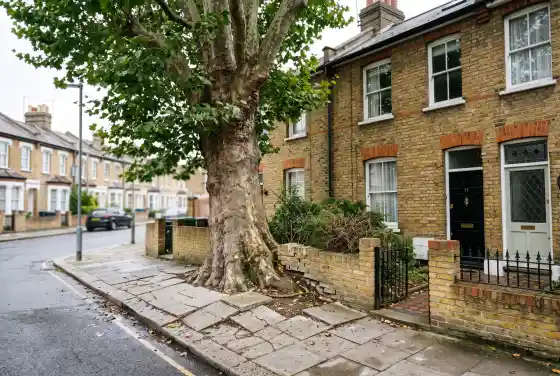
The British Geological Survey says the clay boroughs most exposed to shrink-swell lie in the north and centre of the capital, and Barnet sits on that clay almost throughout. A Mill Hill semi with a century-old oak near the bay is the classic case: in a dry summer the clay under its shallow footings shrinks, and in winter it swells back. On a Level 3 survey in Barnet we map tapering diagonal cracks over openings, a bay pulling away from the main wall and doors that bind, then say whether the subsidence and structural survey or an arboriculturist should follow.
Flood risk is a smaller question here: 2.4% of the borough lies in Flood Zone 3 on the Environment Agency map, which ignores defences. For a house on low ground in Flood Zone 3 or 2, check the postcode on the GOV.UK long-term flood risk service and expect us to look harder at air bricks, low thresholds and any cellar.
Trust consent, Article 4 and the conservation map
There are 16 conservation areas in the borough, and Barnet Council says 10 of them are covered by, or have, Article 4 directions. That means a new dormer, front door or window in Mill Hill, Monken Hadley or Finchley Garden Village may need consent that would not apply two streets away. Hampstead Garden Suburb adds the Trust’s Scheme of Management, whose consent is separate from planning permission, and whose boundary leaves out the Golders Green Crematorium and most of The Bishops Avenue.
The National Heritage List holds 651 entries in the borough, and many are Suburb houses, so a single alteration there can need three consents. On a listed Suburb house our listed building survey spends longer on original clay tiles, casements and roughcast, and on plastic paints that trap water in walls built to breathe. The council’s planning and building control pages hold the conservation maps, and our property law guide for buyers explains how listing and Article 4 work.
Prices, leases and conversions in Finchley and beyond
The median sale was £590,000, above the £518,000 median for the whole capital, because houses rather than flats make up most sales. Barnet semis sold at a median of £810,000, so an unapproved Mill Hill loft or a cracked Edgware bay is a large share of any budget, and a Level 3 survey in Barnet looks hard at both. Only 42.4% of sales were leasehold, so most Barnet buyers own the whole roof, walls and drains and carry every repair alone. Converted houses hold 8.8% of Barnet households, mostly in Finchley’s larger Victorian houses, where fire separation, sound between floors and the freeholder’s consent for alterations come first.
Inside a Mill Hill semi or a Suburb cottage
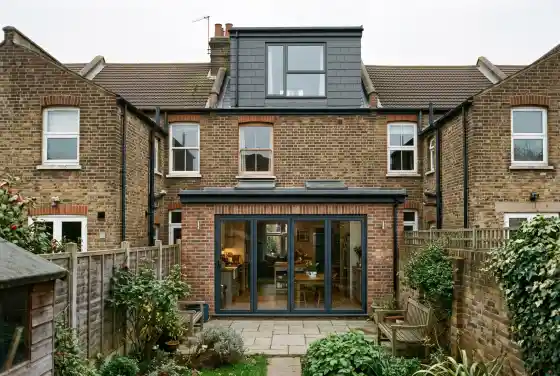
In a Mill Hill semi the surveyor starts at the bay, the side extension and the hip-to-gable loft, checking the steels that replaced removed walls, the flat roof and its outlets, and ventilation to any inner kitchen. A Barnet Level 3 survey of a Suburb cottage starts instead at the steep tile roof, swept dormers, tall chimneys and leaded casements. On the EPC register 45.9% of Barnet homes rate D or below, so the report notes early cavity walls, older boilers and what the MEES rules mean before a Finchley flat is let. Our extended property survey suits the Edgware house extended more than once, and the guide to the report’s contents sets out each section.
Booking an inspection from Edgware to East Finchley
L3S London’s RICS-qualified surveyor inspects, writes and signs every Barnet report to the RICS Home Survey Standard, and a Railway Terraces cottage gets a written fixed fee on the same size basis as a Mill Hill semi. Barnet Council explains on its about building control page why internal alterations can need approval, so send us the address with a note of any work the seller mentions, or price a Totteridge house first with the fee estimator.
Barnet's housing record, set against the capital
| Figure | Barnet | London | What it means for the survey | Source and period |
|---|---|---|---|---|
| Homes built 1919 to 1939 | 33.3% | 22% | A third of homes are interwar, so shallow footings on clay and early cavity walls lead most Barnet reports. | VOA, list at 31 Mar 2026 (162,740 homes) |
| Semi-detached houses, share of homes | 21.8% | 12.1% | Near double the capital's share; the Edgware and Mill Hill bay is where we look first for movement. | VOA, list at 31 Mar 2026 (162,740 homes) |
| Detached houses, share of homes | 7.8% | 3.4% | Totteridge and Monken Hadley houses usually carry several extensions, each inspected as its own structure. | VOA, list at 31 Mar 2026 (162,740 homes) |
| Homes built before 1919 | 19.7% | 28.9% | Solid walls, lime mortar and slate roofs, found mostly in Finchley, Friern Barnet and High Barnet. | VOA, list at 31 Mar 2026 (162,740 homes) |
| Homes built in 2000 or later | 20% | 18.5% | On flats built this century, ask for fire safety papers and the new-build warranty. | VOA, list at 31 Mar 2026 (162,740 homes) |
| Median price paid, all homes | £590,000 | £518,000 | Above the capital because houses, not flats, make up most sales here. | HM Land Registry, sales Oct 2025 to Sep 2026 (2,389 sales) |
| Median price paid, semi-detached houses | £810,000 | £625,000 | At this price an unapproved Mill Hill loft or a cracked Edgware bay is a large share of the budget. | HM Land Registry, sales Oct 2025 to Sep 2026 (722 sales) |
| Share of sales that were leasehold | 42.4% | 50.8% | Under half of sales; on a freehold semi the buyer carries every roof and wall repair alone. | HM Land Registry, sales Oct 2025 to Sep 2026 (2,389 sales) |
| Households in part of a converted or shared house | 8.8% | 11.1% | Fewer than the capital's share, concentrated in Finchley's larger Victorian houses. | ONS Census 2021, 21 Mar 2021 (148,917 households) |
| Homes rated D or below | 45.9% | 45% | Early cavity walls, older boilers and the MEES rules if a Finchley flat is to be let. | EPC register, certificates to 12 Oct 2026 (131,931 homes) |
| Conservation areas (distinct names) | 16 | n/a | Includes Hampstead Garden Suburb, where Trust consent is needed as well as planning permission. | MHCLG planning data, published Nov 2026 |
| Listed building entries | 651 | n/a | Many are Suburb houses, where listed building consent adds a third layer of control. | Historic England list, published Nov 2026 |
| Share of the borough in Flood Zone 3 | 2.4% | n/a | Flood Zone 3 ignores defences; check the exact postcode on GOV.UK before buying on low ground near a Barnet brook. | Environment Agency, published Nov 2026 |
Data: Valuation Office Agency: Council Tax stock of properties 2026; HM Land Registry Price Paid Data; ONS Census 2021; Energy Performance of Buildings Register (domestic EPCs); planning.data.gov.uk: conservation areas (MHCLG); Historic England National Heritage List for England, via planning.data.gov.uk; Environment Agency Flood Map for Planning (flood zones), via planning.data.gov.uk. Open Government Licence v3.0.
Questions from Barnet buyers
Do I need the Hampstead Garden Suburb Trust's consent as well as planning permission?
For most outside changes to a house inside the Trust's Scheme of Management, yes, and it is separate from Barnet Council's planning permission. The council notes the Scheme leaves out the Golders Green Crematorium and most of The Bishops Avenue, so the two boundaries differ. Where a Suburb house has new windows or a dormer, the report tells your conveyancer to ask for both consents.
Are 1930s semis in Edgware and Mill Hill prone to subsidence?
Interwar houses are 33.3% of the stock, and most Edgware and Mill Hill semis stand on clay on footings far shallower than a modern house. The British Geological Survey names northern and central boroughs of the capital among the most exposed to clay shrink-swell. On a Level 3 survey in Barnet we record each crack's width and direction and say whether a structural engineer or monitoring is needed before exchange.
Which Barnet conservation areas carry Article 4 directions?
The council says 10 of its 16 conservation areas are covered by, or have, Article 4 directions. The national planning data maps directions in Hampstead Garden Suburb, Mill Hill, Monken Hadley, Hendon The Burroughs and Finchley Garden Village among others. Check Barnet Council's map for the exact line at your street before you plan a dormer in Mill Hill or Monken Hadley.
What should a survey say about a large rear extension in Finchley?
It should explain how the Finchley extension is tied to the house, whether the junction has cracked, the state of the flat roof and what now carries the load where walls came out. Our Barnet report lists the planning and building control certificates your conveyancer needs, and flags Party Wall Act questions where the Finchley extension sits on the boundary.
Is a Watling Estate cottage in Burnt Oak worth a full building survey?
The Watling Estate is an interwar council cottage estate and a conservation area, so replaced windows, porches and doors may have needed consent. A Burnt Oak cottage of the 1920s also has the shallow footings and early cavity walls of its age. A Barnet Level 3 survey covers both, and says which alterations your conveyancer should ask the seller about.
Sources
- Barnet Council: planning and building control (checked 26 November 2026)
- Barnet Council: about building control (checked 26 November 2026)
- Barnet Council: conservation areas (checked 26 November 2026)
- Barnet Council: Hampstead Garden Suburb conservation area (checked 26 November 2026)
- British Geological Survey: climate-related subsidence maps (checked 26 November 2026)
- planning.data.gov.uk: Article 4 direction areas (checked 26 November 2026)
- VOA: Council Tax stock of properties 2026 (checked 26 November 2026)
- HM Land Registry: Price Paid Data (checked 26 November 2026)
- GOV.UK: Get energy performance of buildings data (checked 26 November 2026)
- GOV.UK: Check your long term flood risk (checked 26 November 2026)
- Historic England: search the National Heritage List (checked 26 November 2026)