
Westminster districts and the buildings behind their front doors
| Area | Homes you mostly find | What the surveyor checks first |
|---|---|---|
| Maida Vale and Little Venice (W9) | Edwardian red-brick mansion blocks along Elgin Avenue and Randolph Avenue, and stucco villas by the canal | Asphalt roofs, internal valley gutters, old steel or sash windows and cast-iron drainage stacks |
| St John's Wood (NW8) | Early Victorian villas, some still single houses, beside 1930s mansion blocks and newer apartment buildings | Lift and boiler age in the blocks, Article 4 rules on Abbey Gardens, basement extensions to villas |
| Marylebone, Harley Street and the Portman Estate (W1) | Georgian and Victorian terraces converted to flats, and mansion blocks off Marylebone High Street and Baker Street | Timber lintels, bowed front walls, joists notched for services and the estate landlord's lease terms |
| Mayfair and Belgravia (W1, SW1) | Grand Georgian and stucco houses divided into lateral flats, with mews houses behind | Mansard storeys on old roof timbers, listed interiors and consent for past alterations |
| Pimlico (SW1) | Mid-nineteenth century stucco terraces in a planned grid, nearly all flats, plus the Churchill Gardens estate | Hollow stucco, rusting balconies, damp vaults and the Flood Zone 3 position by the river |
| Bayswater and Paddington (W2) | Stucco terraces and squares, some converted from hotels into flats, around Sussex Gardens and Westbourne Terrace | Fire separation in former hotels, parapet gutters and Article 4 rules in Bridstow Place and Sussex Gardens |
| Soho and Covent Garden (W1, WC2) | Flats above shops, bars and restaurants in buildings from the eighteenth century onwards | Kitchen extract ducts, grease, noise, fire separation and shared refuse areas |
Stucco, stock brick and the mansion block era
The Valuation Office Agency dates 48.4% of Westminster’s homes before 1919, against 28.9% across London, and that age shows in stucco fronts, lime mortar, timber floors and roofs hidden behind parapets from Pimlico to Bayswater. Another 10% went up between the wars, when many of the mansion blocks of Maida Vale and St John’s Wood were built, so steel windows, asphalt flat roofs, early lifts and cast-iron drainage stacks are a large part of a Westminster Level 3 survey in NW8 and W9.
Flats and maisonettes make up 89.2% of the Westminster council tax list, against 57.5% capital-wide. Roofs, façades, lifts, drainage stacks and heating in a Marylebone or Maida Vale block are shared, and their repair comes back to you through the service charge, so we inspect that shared fabric as far as access allows and record what was out of reach.
Mansion blocks, estates and historic estate leases
At the 2021 Census 70.2% of Westminster households lived in a purpose-built block, from Edwardian red-brick mansion flats on Elgin Avenue to the post-war Churchill Gardens estate in Pimlico. Top-floor flats in Maida Vale blocks often show damp below failing roof coverings, and rooms with old single glazing show condensation. For a Maida Vale or St John’s Wood block, our flat and mansion block survey covers the common parts we can reach and lists questions for the managing agent.
Leasehold sales were 87.8% of everything HM Land Registry recorded in Westminster in the year to September 2026, and large parts of Marylebone, Mayfair and Belgravia belong to historic estates such as the Portman Estate, so you may be buying a lease from an estate landlord. The lease length, the estate’s repair and alteration rules and the service charge history weigh as much as the condition of a Marylebone flat, and the report turns what we see into questions for your solicitor.
Private renting covered 43.3% of Westminster households in 2021, and on the energy register 9.4% of homes are rated E, F or G. A Bayswater or Pimlico flat rated F or G cannot be let under the minimum energy efficiency standard until it reaches E or has an exemption, and single-glazed sashes inside conservation areas limit the easy fixes.
Flats over Soho restaurants and Edgware Road shops
The 2021 Census put 2.1% of Westminster households in a commercial building such as a flat over a shop, above the capital’s 1.4%. In Soho, Covent Garden and along Edgware Road that means kitchen extraction, smells, noise, fire separation and shared refuse areas, and roof plant fitted by commercial tenants can damage the roof coverings over your flat. A Level 3 survey in Westminster on a flat over a restaurant is easiest before trading starts, when rear yards and shared areas are quiet, and a mixed-use property survey frames the shared costs for your solicitor.
Stucco terraces by the Thames and Flood Zone 3
Environment Agency mapping puts 16.9% of Westminster in Flood Zone 3, mostly the low ground by the Thames, including much of Pimlico; the zones ignore the Thames Barrier and river walls, so they show exposure rather than likelihood. For a Pimlico lower ground flat, check the address on the GOV.UK long term flood risk service, which also covers surface water, and expect the report to look hard at vaults, lightwell drains and any pumped drainage.
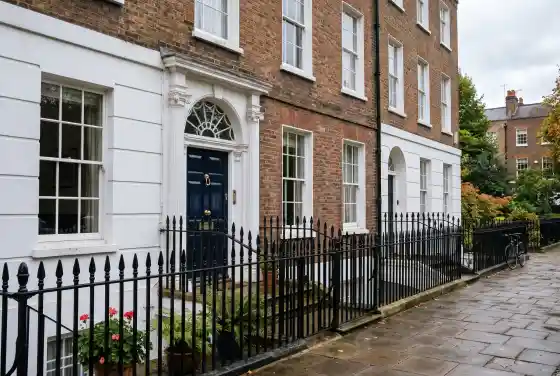
On Pimlico, Bayswater and Belgravia stucco we tap the render to find hollow areas that have lost their key, and look for rusting iron balconies and railings, porches pulling away from the front wall and leaking parapet gutters. Georgian townhouses in Marylebone and Mayfair add timber lintels, bowed front walls, floor joists notched for services and mansard storeys built on the original roof timbers.
Conservation areas, listing and the City Plan basement policy
The national planning dataset shows 56 conservation areas covering 77% of Westminster’s land, from Royal Parks and Regent’s Park to Mayfair, Maida Vale and Pimlico. Westminster City Council publishes an audit or guide for each on its conservation areas page, and inside them windows, roof extensions, rooftop plant, shopfronts and trees usually need consent. Historic England lists 4,015 entries in Westminster, while the City Plan counts over 11,000 listed buildings and structures because one entry often covers a whole Belgravia or Pimlico terrace; for a listed Mayfair house a listed building survey is the closer fit.
The council’s Article 4 directions page lists a City-wide direction, in force since 31 July 2016, that removes permitted development rights for basements, plus local directions on minor alterations in Abbey Gardens, Bridstow Place and Bristol Gardens. New basements are then tested against Policy 50 of the City Plan 2019 to 2040, which asks for a structural methodology statement and, in Flood Zone 2 or 3, a flood risk assessment. Past consents for a St John’s Wood or Belgravia basement can be checked through Westminster’s planning applications search, and the completion certificate through Westminster building control. Our guide to property law for buyers explains how listing, Article 4 and party walls affect a purchase.
Prices from Pimlico flats to Belgravia houses
The median price paid across Westminster was £790,000 in the year to September 2026, against £518,000 for the capital as a whole. A flat sold for a median £725,000 and a terraced house for £1,950,000, so on a Marylebone or Belgravia house the inspection concentrates on roofs, façades, basements and past alterations. The Westminster median was 13.7% lower than the year before, but medians move with the mix of Mayfair houses and Pimlico flats sold, so the fall is not a measure of any one home’s value.
Booking a Westminster inspection
L3S London carries out RICS Level 3 Building Surveys on Westminster homes from Maida Vale mansion flats to Pimlico stucco conversions, each inspected and signed by an RICS-qualified surveyor. Most Maida Vale and St John’s Wood blocks have a porter or managing agent holding the roof and plant room keys, so ask the selling agent to book access, or those areas are rated NI. Part of the City is inside the Congestion Charge zone, and surveyors heading to Soho or Mayfair often travel by public transport with a pole camera rather than long ladders.
The City of Westminster by the numbers
| Figure | Westminster | London | What it means for the survey | Source and period |
|---|---|---|---|---|
| Homes built before 1919 | 48.4% | 28.9% | Nearly half of Westminster's homes predate 1919, so stucco, lime mortar, timber floors and parapet roofs are routine from Pimlico to Bayswater. | VOA, list at 31 Mar 2026 (131,940 homes) |
| Homes built 1919 to 1939 | 10% | 22% | The interwar decades added many mansion blocks in St John's Wood and Maida Vale, with steel windows and asphalt roofs to check. | VOA, list at 31 Mar 2026 (131,940 homes) |
| Flats and maisonettes, share of homes | 89.2% | 57.5% | Nine in ten Westminster homes are flats, so the shared roof, façade, lift and drains matter as much as the flat itself. | VOA, list at 31 Mar 2026 (131,940 homes) |
| Households in a purpose-built block of flats | 70.2% | 40.3% | Mansion blocks and estates such as Churchill Gardens dominate; block roofs, lifts, heating and the reserve fund drive the service charge. | ONS Census 2021, 21 Mar 2021 (94,814 households) |
| Households in a commercial building, for example over a shop | 2.1% | 1.4% | Flats over Soho restaurants and Edgware Road shops are common, bringing extract ducts, noise and fire separation into the report. | ONS Census 2021, 21 Mar 2021 (94,814 households) |
| Households renting privately | 43.3% | 30% | A large Marylebone and Bayswater letting market, so the MEES rating and any landlord's alterations need checking. | ONS Census 2021, 21 Mar 2021 (94,816 households) |
| Share of sales that were leasehold | 87.8% | 50.8% | Almost every Westminster sale is a lease, often from a historic estate, so lease length and repair clauses sit beside the building's condition. | HM Land Registry, sales Oct 2025 to Sep 2026 (1,429 sales) |
| Median price paid, all homes | £790,000 | £518,000 | Well above the capital-wide median, so one failed Maida Vale roof or unapproved Belgravia basement is a very large sum. | HM Land Registry, sales Oct 2025 to Sep 2026 (1,429 sales) |
| Median price paid, flats and maisonettes | £725,000 | £425,000 | The typical flat sale, from a Pimlico conversion to a St John's Wood block; shared repair costs are worth pinning down first. | HM Land Registry, sales Oct 2025 to Sep 2026 (1,245 sales) |
| Median price paid, terraced houses | £1,950,000 | £585,000 | Terraced houses in Marylebone, Mayfair or Belgravia sell at well over double the flat median, with roofs, façades and basements to price. | HM Land Registry, sales Oct 2025 to Sep 2026 (159 sales) |
| Change in median price paid on the year before | -13.7% | -2.3% | The median follows the mix of Mayfair houses and Pimlico flats sold in the year; it is not a change in any one home's value. | HM Land Registry, Oct 2025 to Sep 2026 v the year before (3,780 sales) |
| Homes rated E, F or G | 9.4% | 10.5% | A Bayswater or Pimlico flat rated F or G cannot be let under the MEES rules until it reaches E or has an exemption. | EPC register, certificates to 12 Oct 2026 (110,211 homes) |
| Share of the borough in Flood Zone 3 | 16.9% | n/a | Low ground by the Thames, including much of Pimlico (zones ignore defences); check the address and look hard at vaults and lightwells. | Environment Agency, published Nov 2026 |
| Conservation areas (distinct names) | 56 | n/a | From Royal Parks and Regent's Park to Mayfair, Maida Vale and Pimlico, each with an audit or guide from Westminster City Council. | MHCLG planning data, published Nov 2026 |
| Share of the borough inside a conservation area | 77% | n/a | Most of the City is inside a conservation area, so windows, roof extensions, rooftop plant and shopfronts usually need consent. | MHCLG planning data, published Nov 2026 |
| Listed building entries | 4,015 | n/a | One entry can cover a whole Belgravia or Pimlico terrace, which is why the City Plan counts over 11,000 listed buildings and structures. | Historic England list, published Nov 2026 |
Data: Valuation Office Agency: Council Tax stock of properties 2026; ONS Census 2021; HM Land Registry Price Paid Data; Energy Performance of Buildings Register (domestic EPCs); Environment Agency Flood Map for Planning (flood zones), via planning.data.gov.uk; planning.data.gov.uk: conservation areas (MHCLG); Historic England National Heritage List for England, via planning.data.gov.uk. Open Government Licence v3.0.
Questions from Westminster buyers
What should a survey cover on a Maida Vale mansion flat?
On a Maida Vale block we inspect the flat in detail and the common parts we can reach: entrance, stairs, lift lobby, visible roofs, and the external walls and windows from ground level. Maida Vale blocks on Elgin Avenue and Randolph Avenue often have original steel windows or timber sashes, asphalt roofs and old cast-iron drainage stacks. The report lists questions for the Maida Vale managing agent about planned works, reserve funds and the lease.
How much of Westminster lies in a conservation area, from Mayfair to Maida Vale?
Westminster City Council has 56 conservation areas, and the City Plan 2019 to 2040 says they cover about 78% of the City. Most homes you view in Westminster will be in one, which affects windows, roof extensions, plant on roofs, shopfronts and trees, so read the Westminster City Council audit for your street before you plan alterations.
Can I get a Level 3 survey on a flat above a restaurant in Soho?
Yes, and it is worth having. Flats above Soho restaurants and bars face kitchen extract ducts, grease, smells, noise, fire separation and shared waste and delivery areas. We report on what we can see in the Soho building, including the separation between the two uses, and your solicitor checks the lease for how repairs and insurance are shared with the commercial tenant on the ground floor.
Does Westminster allow basement extensions?
Westminster removed permitted development rights for basements across the whole City by an Article 4 direction in force since 31 July 2016, so a new basement needs planning permission. Policy 50 of the City Plan 2019 to 2040 then sets the tests, including a structural methodology statement and, in Flood Zone 2 or 3, a flood risk assessment. For a Belgravia or Marylebone flat with an existing basement, your solicitor should check the lease includes it and the freeholder consented.
I am buying a listed flat in Pimlico. Does that change the Level 3 survey?
It changes the advice more than the inspection on a Pimlico flat. We still inspect the Pimlico flat and the visible fabric, but repair advice respects the listing: overhauling sash windows rather than replacing them, and lime-based materials on stucco and brick. Unauthorised alterations by previous owners pass to you, so the report flags anything in the Pimlico flat that looks recent and unapproved.
Sources
- Westminster City Council: Planning applications (checked 26 November 2026)
- Westminster City Council: Building control (checked 26 November 2026)
- Westminster City Council: Conservation areas (checked 26 November 2026)
- Westminster City Council: Article 4 Directions in Westminster (checked 26 November 2026)
- Westminster City Plan 2019-2040 (January 2026), including Policy 50 Basement developments (checked 26 November 2026)
- GOV.UK: Check long term flood risk (checked 26 November 2026)
- GOV.UK: Domestic private rented property minimum energy efficiency standard, landlord guidance (checked 26 November 2026)
- Historic England: Search the List (checked 26 November 2026)